
[Stay on top of transportation news: Get TTNews in your inbox.]
ATA’s Costello says freight recovery has legs despite headwinds
Reduction in capacity has shifted the balance between supply and demand and pushed rates higher
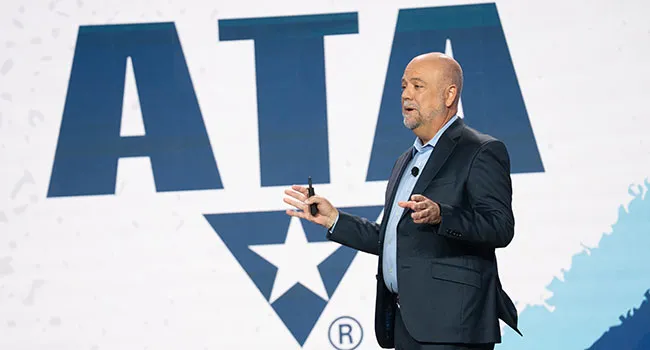
 “We are in a cycle like we have never seen before,” ATA Chief Economist Bob Costello said. “And it is all supply driven.” (Karen Foote/American Trucking Associations)
Key Takeaways:
- ATA Chief Economist Bob Costello said trucking’s recovery is continuing as capacity shrinks despite stagnant freight demand.
- Truckload revenue per mile fell 8.4% from 2022 through 2025 as nonfuel operating costs rose more than 13%, forcing carriers out.
- Costello said fleets are unlikely to quickly rebuild capacity because projected 14% Class 8 sales growth largely reflects pent-up replacement demand.
CHARLOTTE, N.C. — The trucking industry’s ongoing recovery from a prolonged freight recession appears to have staying power despite a mounting list of economic headwinds, the chief economist at American Trucking Associations said.
Bob Costello reiterated that tighter capacity rather than stronger freight demand is driving the improvement in trucking conditions during an Oct. 19 presentation at ATA’s 2026 Management Conference & Exhibition.
“We are in a cycle like we have never seen before,” Costello said. “And it is all supply driven.”
Freight volumes remain mostly stagnant, with pockets of strength in certain sectors and regions, but the reduction in freight hauling capacity has shifted the balance between supply and demand and pushed rates higher.
That supply rebalancing has happened in two phases, Costello said.
From 2022 through 2025, truckload revenue per mile dropped 8.4%, while operating costs climbed more than 13% excluding fuel expenses and surcharges, he said, citing data from ATA and the American Transportation Research Institute.
Those challenging business conditions pushed many motor carriers out of business but not quickly enough to restore balance.
More recently, a second wave of capacity reductions has accelerated the market shift.
This year’s heightened enforcement of trucking safety regulations has been purging “shadow capacity” from the market, Costello said. Those actions include greater scrutiny of truck driver training standards, enforcement of English-language proficiency requirements and closer vetting of non-domiciled commercial driver licenses, B-1 visa rules and electronic logging device compliance.
Image
Current distillate stocks are historically low for this time of year, which could be a warning sign for diesel prices, Costello said. (Karen Foote/American Trucking Associations)
On the demand side, however, the broader economy is providing little momentum for freight.
Factory output is up 1.3% this year through September, Costello said, but much of that growth came from the aerospace sector and from computer and electrical equipment, much of which is tied to the boom in artificial intelligence and investments in data centers. Remove those three categories, which collectively represent only about 10% of manufacturing, and factory output was essentially flat.
A similar pattern is unfolding in construction. Data center construction has surged nearly 34% year to date, but overall nonresidential construction dropped 4.9%.
AI infrastructure has become an increasingly important pillar of the broader economy, Costello said.
He projected that real gross domestic product will expand 2.4% this year, but that growth would amount to only 0.6% with AI-related investment removed from the calculation.
The AI boom is helping to offset a series of headwinds, including effective tariff rates that remain historically high at 11%, along with inflation and higher interest rates.
This year’s surge in fuel costs has emerged as another major challenge.
RELATED: Fuel prices rank as trucking’s most pressing concern
Current distillate stocks are historically low for this time of year, which could be a warning sign for diesel prices, Costello said.
“That does not bode well for the prices going into this fall freight season and later on this year,” he said.

PCS Software CEO Mark Hill discusses the advance of AI in the trucking industry. Tune in above or by going to RoadSigns.ttnews.com.
The United States and other countries have been releasing more oil into the open market, which has prevented crude oil prices from climbing even higher. However, the U.S. Strategic Petroleum Reserve is now “about as low as we can get,” he said.
Although freight rates have improved, Costello does not expect fleets to quickly rebuild excess capacity, noting that projected 14% growth in Class 8 retail sales this year largely reflects pent-up replacement demand from deferred truck purchases.
His bottom line for attendees was that the ongoing supply-driven recovery is poised to continue for a while.
“I think we’ve got some runway here,” Costello said.


